


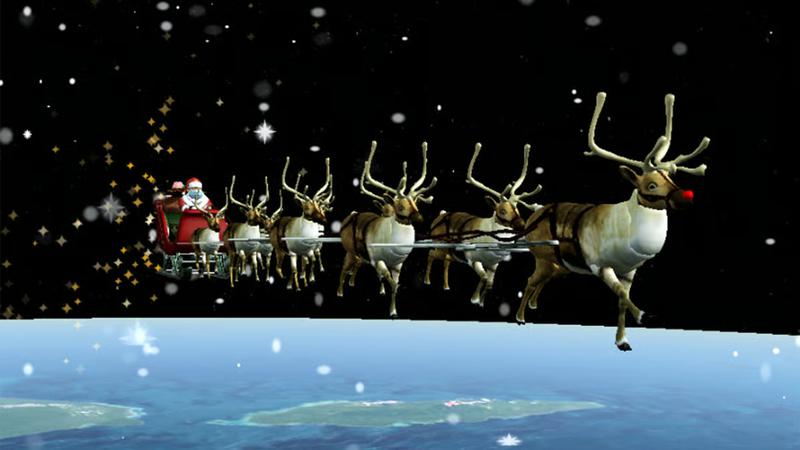
NANAIMO — A vast network of civilian and military professionals are keeping a watchful eye on Santa Claus this holiday season.
As they’ve done since 1955, staff at the North American Aerospace Defense Command (NORAD) is tracking Santa and his sleigh as he makes the journey from the North Pole, around the world and back in around 34 hours of travel time.
NORAD Lt. General Case Cunningham said things kick off on Tuesday, Dec. 23 in North America, as Santa heads south to start his journey and make the first deliveries in the South Pacific Islands, New Zealand and Australia.
“We’ve got radars that are across Alaska and Canada, that’s the Northern Warning System, so as soon as Santa takes off from the North Pole, those radars are going to detect Santa’s departure…and then typically we see Santa make his way across the International Date Line there towards the west.”
Aircraft tracking website FlightRadar24 reported Santa conducted a test flight around northern Europe and Greenland on Tuesday, likely one of the final flights before his annual journey.
Santa was spotted on radar travelling at around 60,000 feet, roughly twice the height of commercial airline traffic.
Satellites in orbit help keep track of Santa as he heads over the Pacific Ocean, as well as in more remote areas where radar technology isn’t feasible.
“A little-known fact is that Rudolph’s noes that glows red also emanates a lot of heat, and so those satellites track him through that heat source,” Cunningham added.
The first public Santa alert came in 1948 from the United States Air Force, but it wasn’t until seven years later when a number appeared in a Colorado newspaper telling kids they could call Santa directly.
A misprint accidentally had kids calling the Continental Air Defense Command offices instead.
NORAD assumed responsibility for Santa tracking in 1958.
Families looking to connect live with staff monitoring Santa’s progress can call 1-877-HI-NORAD (1-877-446-6723) for updates on his location, or use NORAD’s smartphone apps for a live map.
Cunningham said one of the final legs of Santa’s journey takes him over North America where he’ll be under a safe escort.
” As Santa makes his way back to North America, we have our fighter aircraft that will help guide Santa along his way, both Canadian and United States aircraft.”
Santa is estimated to travel around 1,050 kilometres per second, around 3,000 times the speed of sound, covering around 120 million kilometres in one night.
Local news. Delivered. Free. Subscribe to our daily news wrap and get our top local stories delivered to your email inbox every evening.
info@nanaimonewsnow.com
Follow us on: Twitter (X) | Bluesky | Facebook